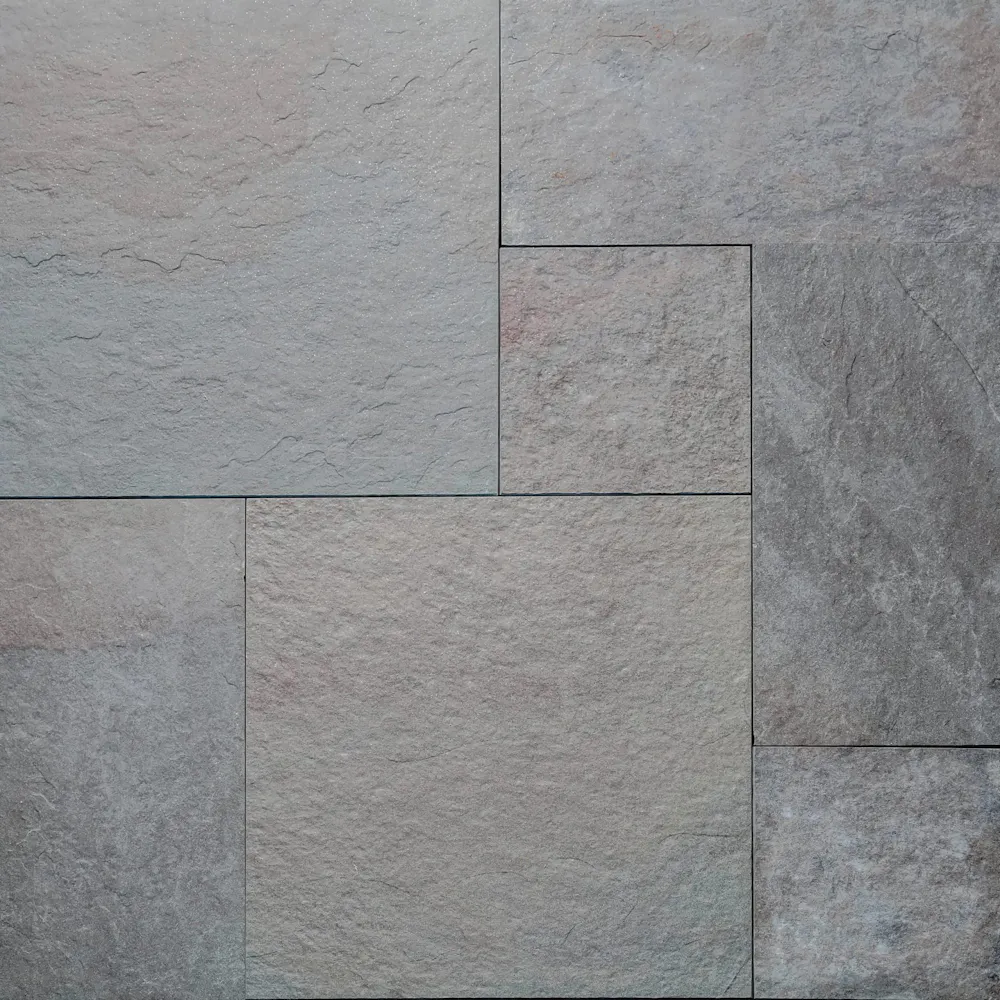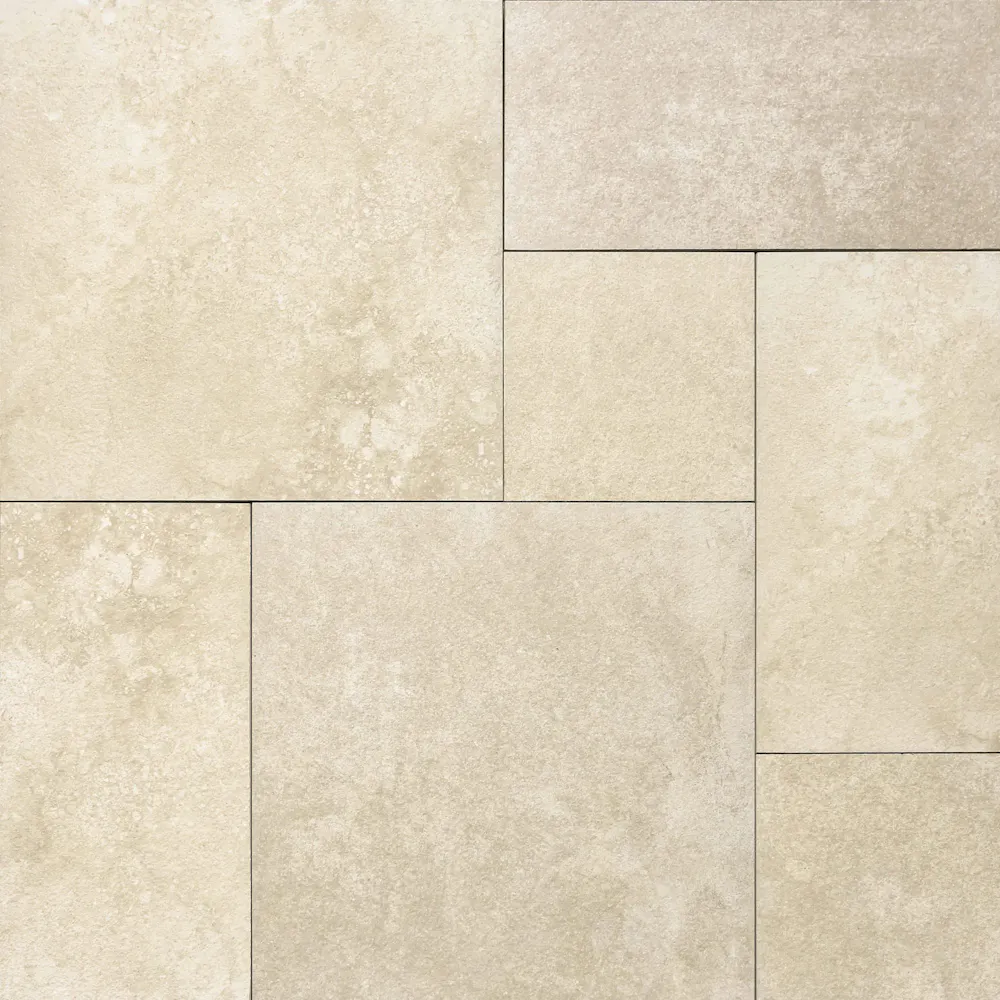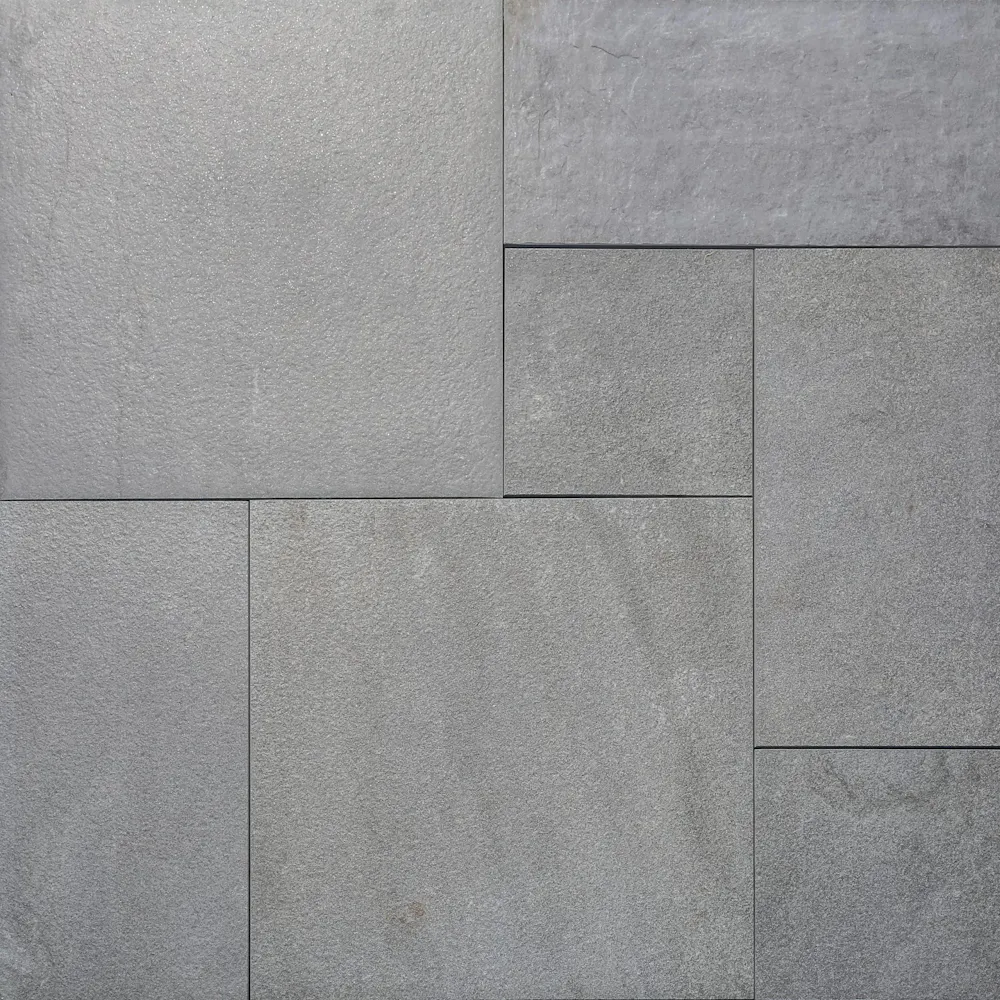
Thermal Blue
Consistent coloring, a standard for pools and patios.
- 12 × 12
- 12 × 24
- 24 × 24
- 12 × 48
- 24 × 48

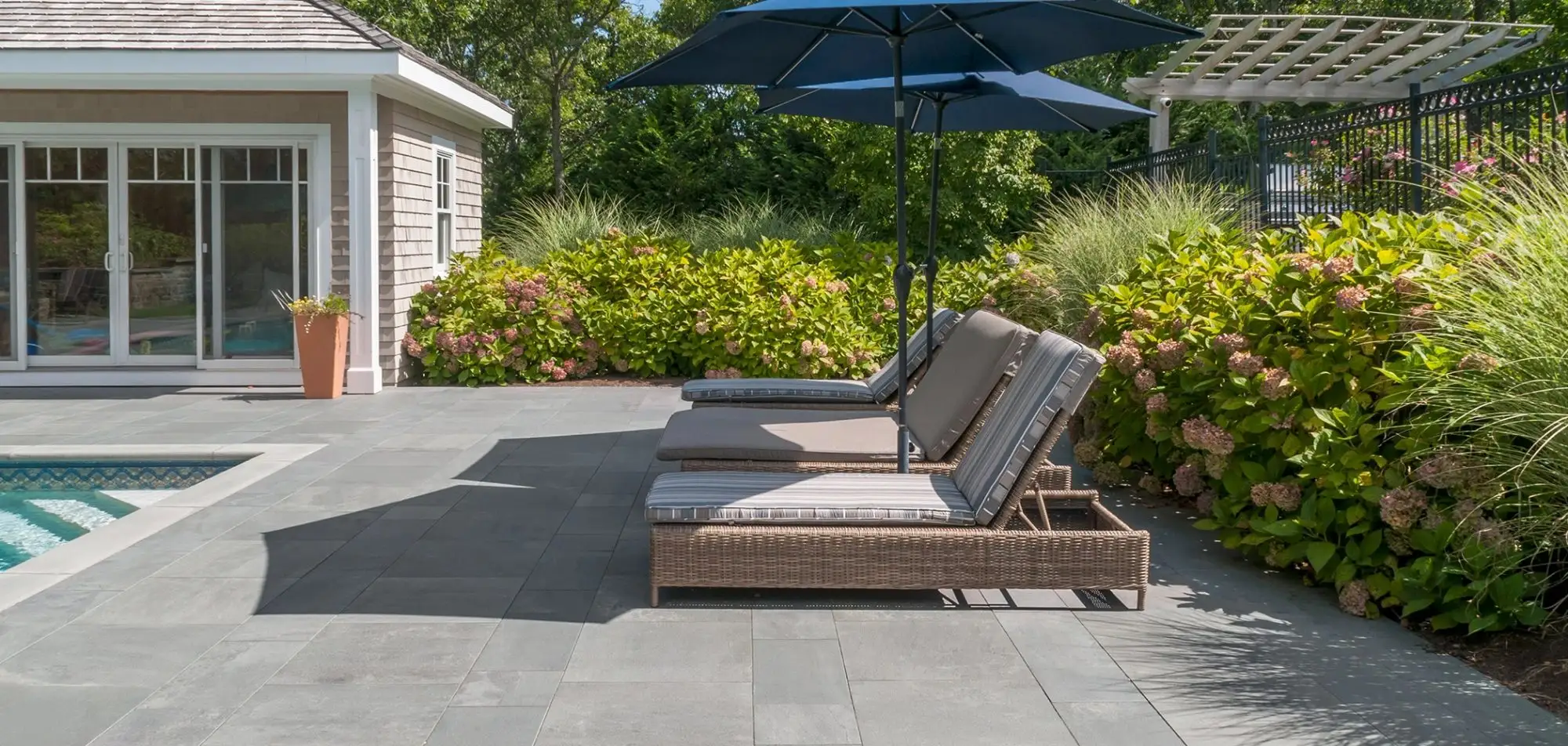
Bluestone is the traditional choice in the Northeast. Here is how ¾″ outdoor porcelain compares, measured against Pennsylvania bluestone.
Pennsylvania bluestone is a sedimentary rock quarried in the Northeast, and it has paved patios and pool decks for generations. Its drawbacks are well known to anyone who has maintained one: it absorbs water, it shales and flakes after repeated freeze–thaw cycles, it fades in strong sun, and it stains.
Everblue is porcelain rather than quarried stone, made to look like bluestone while avoiding those failure modes. The table below uses Everblue's published figures against typical Pennsylvania bluestone.
| Characteristic | Everblue porcelain | Pennsylvania bluestone |
|---|---|---|
| Water absorption | 0.05% | 1.6% |
| Stain resistance | Resistant to all tested agents | Not guaranteed |
| Chemical resistance | Resistant | Not guaranteed |
| Fading under sunlight and UV | No fading or color change | Changes color |
| Surface fragility | No flaking or crumbling | Flakes and crumbles |
| Length and width | Dimensions guaranteed | Not guaranteed |
| Uniform thickness | Guaranteed | Not guaranteed |
| Frost and salt resistance | Guaranteed | Not guaranteed |
| Slip resistance | Guaranteed | Not guaranteed |
| Pedestal / raised floor install | Guaranteed | Not guaranteed |
| Weight | 9.38 lb/ft² | 22.5 lb/ft² (thermal) · 32.7 lb/ft² (variegated) |
| Breaking / flexural strength | 3,800 lbf | 1,900 lbf |
Source: Everblue 2026 Lookbook. Bluestone figures are typical values for Pennsylvania bluestone.
Bluestone is genuine quarried stone with the variation and history that comes with it, and on a restoration or a historic property it can be the right answer. Reclaimed and irregular-cut bluestone also does things a rectified porcelain paver cannot. The comparison above is about performance, not about taste.
Everblue is tested at a dynamic coefficient of friction above 0.60 both wet and dry, measured to ANSI A137.1 / A326.3. It also rates R11 on the German shod ramp test and A+B+C on the barefoot ramp test, which is the classification used for barefoot wet areas such as pool surrounds. Natural bluestone is not consistently rated, because every slab differs.
Freeze–thaw damage happens when water soaks into stone, freezes and expands. Everblue absorbs 0.5% of its weight in water or less, tested to ASTM C373-88, and passes ASTM C1026 frost resistance with no visible defects after repeated freezing and thawing. Pennsylvania bluestone typically absorbs around 1.6%, which is why bluestone patios shale and flake over winters.
Everblue is sold through supply yards and distributors who quote by the square foot for your project, so pricing depends on size, quantity and region. Ask any Everblue dealer for a quote. Worth weighing alongside the material price: porcelain needs no sealing, and consistent thickness means less time spent shimming and sorting on site.
No. The color is fired through the porcelain body rather than applied as a surface treatment, and Everblue is rated for no fading or color change on exposure to light and UV. Bluestone changes color over time with sun exposure.
Yes, and weight is the reason they are often specified there. Everblue weighs about 9 lb per square foot, against roughly 22.5 lb for thermal bluestone and 32.7 lb for variegated. It can be dry-laid on pedestals over a concrete pad, with fixed-height support pads at every corner.
Everblue is rated above 2,500 lbf breaking strength and above 7,000 psi modulus of rupture, roughly double typical bluestone at the same ¾″ thickness. A 24 × 24 paver carries over 1,700 lbf at the centre. That covers pedestrian terraces, pool decks and roof decks. Vehicular use is a different specification; ask your dealer before planning a driveway.
Everblue is rated Class 5 for stain resistance to ASTM C1378, the highest class, and resistant to chemicals to ASTM C650. Stain resistance on bluestone is not guaranteed, which is why sealing is usually recommended on natural stone.
Five ways: dry-laid on a draining base, on sand over a compacted base, on a concrete pad, on pedestals for roof decks, or wet-laid with cementitious adhesive. Everblue is set with ³⁄₁₆″ spacers and must never be plate compacted after laying. Full detail is in the Everblue installation guide, and you should work with a professional, certified installer.
Every Everblue paver: ¾″ outdoor porcelain, tested to ASTM, ISO and EN standards. Figures below are from the Everblue installation guide.Slip resistance test data
| Characteristic | Test standard | Result |
|---|---|---|
| Thickness | ASTM C499 · ISO 10545-2 | ¾″ |
| Weight | — | 9 lb/ft² |
| Water absorption | ASTM C373-88 · ISO 10545-3 | ≤ 0.5% (certified porcelain tile) |
| Breaking strength | ASTM C1505 · ISO 10545-4 | > 2,500 lbf |
| Modulus of rupture | ISO 10545-4 | > 7,000 psi |
| Bending strength | EN 1339 | 14.38 kN, Class 14 |
| Static load, 24 × 24 paver | EN 12825 | Centre > 1,700 lbf · Side > 1,200 lbf · Diagonal > 1,500 lbf |
| Impact resistance | ISO 10545-5 | > 0.55 |
| Abrasion resistance | ISO 10545-6 | < 175 mm², conforms |
| Frost resistance | ASTM C1026 · ISO 10545-12 | Resistant, no visible defects after repeated freeze–thaw |
| Thermal shock resistance | ASTM C484 · ISO 10545-9 | Resistant |
| Chemical resistance | ASTM C650 · ISO 10545-13 | UB min UA · acids and alkalis ULA/UHA |
| Stain resistance | ASTM C1378 · ISO 10545-14 | Class 5, the highest class |
| Fire resistance | EN 13501-1 | A1 / A1FL |
| Dynamic coefficient of friction | ANSI A137.1 / A326.3 | > 0.60 wet · > 0.60 dry |
| Barefoot ramp test | ANSI A326.3 · DIN 51097 | A + B + C |
| Shod ramp test | DIN 51130 | R11 |
| Slip resistance | B.C.R.A. (DM 236/89) | > 0.40 |
Coping is available for Thermal Blue, Natural Variegated and Sand.
Everblue can be dry-laid on a draining base, on sand over a compacted base, on a concrete pad, on pedestals for roof decks, or wet-laid with cementitious adhesive. Pavers are set with ¾6″ spacers and must never be plate compacted. Always work with a professional, certified installer.
Full installation guide (PDF)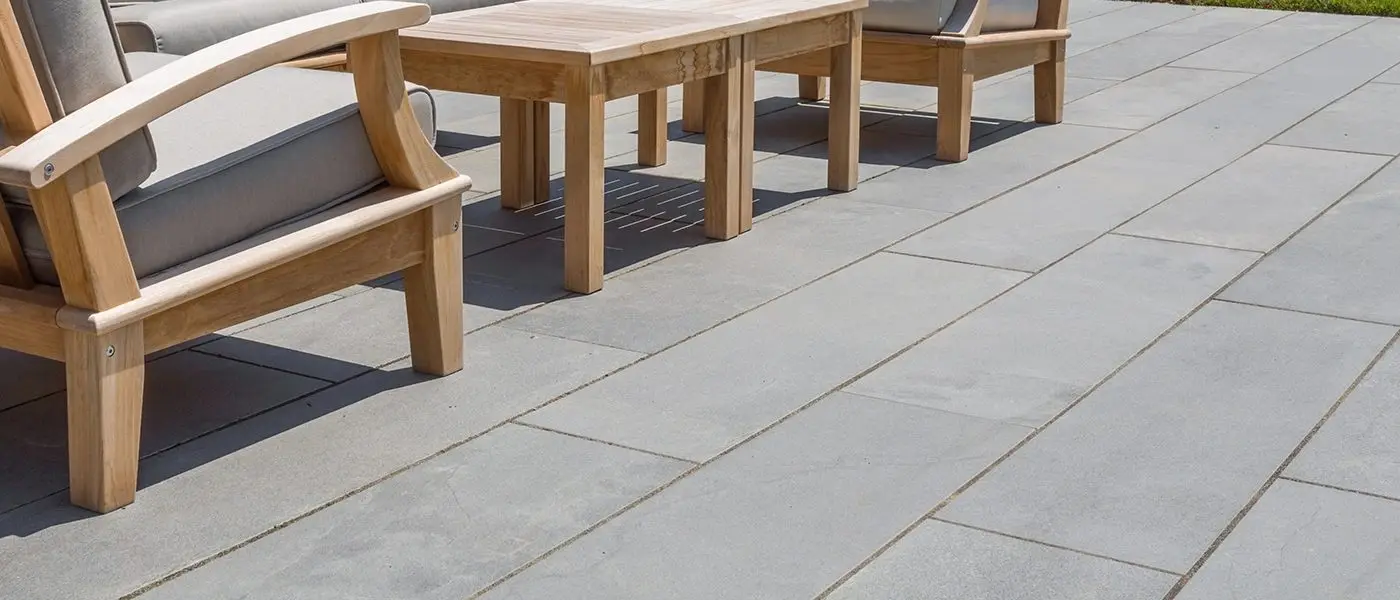
Photos only go so far. Request samples or product information and we’ll get back to you.